This article addresses aspects of the calendar system God put in place to identify weekly sabbaths and feasts that he created for humans to participate in.
The Weekly Sabbath is the seventh day of the week where days are numbered 1 through seven.
We do not have a calendar from the first seven days of creation. Therefore, it is reasonable to conclude in the absence of compelling evidence to the contrary that the days of the week we have are rightly numbered. Therefore, Saturday is the seventh day of the week.
Of course, by God’s time system days start in the evening. Therefore, the word Saturday refers to the daylight part of the day such that Saturday starts at evening Friday and runs to right before evening on Saturday,
Reportedly under God’s system the New Moon identifies the start of each month. In Exodus 12:2 right before God brought the Israelites out of Egypt God told them that New Moon would be the beginning of months for the nation.
Yet, there are writings that say God uses a 364-day calendaring system based on the sun not the moon. Two of these writings are the Book of Enoch and the Book of Jubilees. The reference section contains a link to my article on the 364-day calendar.
There are at least two ways folks use the New Moon to determine what they consider to be the biblical calendar for weekly sabbaths and annual feast.
One way is to use the New Moon to determine when the month begin but have the days of the week, 1 through 7 the same for each week, month, and year so that the daylight portion of the Sabbath is always on a Saturday on the Gregorian Calendar.
Another method uses the New Moon to determine when the month begins and then count seven day increments from that new moon to define the Sabbath. That means the Sabbath will be on different Gregorian Calendar days of the week dependent on what Gregorian Calendar day of the week the New Moon comes in. For example, for November and December 2024 we have:
- New moon of November 1, 2024 which is a Friday (Thursday even to Friday even); so 1st Sabbath is November 6-7 which is Wednesday even to Thursday even.
- A variation of that is to not count the New Moon Day as a day of the week so that the 1st Sabbath would be November 7-8 which is Thursday even to Friday even. In this approach the Sabbath always fall on the 8th, 15th, 22nd, and 29th of the month.
- For December 2024, New moon is December 1st which is a Sunday (Saturday even to Sunday even); so 1st Sabbath is December 6-7 which is Friday even to Saturday even.
This article explains how to determine the date for each biblical feast using The National Aeronautics and Space Administration (NASA) Moon Toolset.
Diagrams illustrating information discussed below are found at the end of this document.
On modern day American calendars moon phases are indicated using four symbols: (1) All Black, (2) Part Light to Left, (3) No Black, (4) Part Light to the Right.
All black for a moon phase means end of moon cycle which is actually the fourth quarter.
The date on which this all black symbol occurs is labeled “New Moon”. However, it acutally means no visible moon light at all.
A symbol with part light to left means 1st quarter.
A symbol with no black/darkness at all means full moon which is 2nd quarter.
A symbol with part light to the right means 3rd quarter.
The waxing crescent is the first occurrence of detectable light before 1st quarter.
Hence for calendar purposes the symbol all black actually means new moon to follow at next sign of light.
Let’s a make a few observations about what scripture says.
God in Exodus 12 and 13 provides some instructions to the Israelites as to when the Hebrew New Year was to start.
Exodus 12:1-2
(1) And Jehovah spake unto Moses and Aaron in the land of Egypt, saying,
(2) This month shall be unto you the beginning of months: it shall be the first month of the year to you.
Exodus 13:3-10
(3) And Moses said unto the people, Remember this day, in which ye came out from Egypt, out of the house of bondage; for by strength of hand Jehovah brought you out from this place: there shall no leavened bread be eaten.
(4) This day ye go forth in the month Abib.
(5) And it shall be, when Jehovah shall bring thee into the land of the Canaanite, and the Hittite, and the Amorite, and the Hivite, and the Jebusite, which he sware unto thy fathers to give thee, a land flowing with milk and honey, that thou shalt keep this service in this month.
(6) Seven days thou shalt eat unleavened bread, and in the seventh day shall be a feast to Jehovah.
(7) Unleavened bread shall be eaten throughout the seven days; and there shall no leavened bread be seen with thee, neither shall there be leaven seen with thee, in all thy borders.
(8) And thou shalt tell thy son in that day, saying, It is because of that which Jehovah did for me when I came forth out of Egypt.
(9) And it shall be for a sign unto thee upon thy hand, and for a memorial between thine eyes, that the law of Jehovah may be in thy mouth: for with a strong hand hath Jehovah brought thee out of Egypt.
(10) Thou shalt therefore keep this ordinance in its season from year to year.
In Exodus 13:4 the word Abid reportedly means barley. (Month of Abib is also know as the month of Nisan).
This beginning of the New Year was given to Israel before they left Egypt. Therefore, the observation is that they left Egypt in the month of Abib as given in Exodus 13. Assuming Abib mean barley it is reasonable to suspect that the beginning of they year has a relationship to the state of barley.
Since barley ripens on/about the Spring season, it is reasonable to conclude there is a relationship between the state of barley and the start of Spring.
The question then becomes what exact state of barley does Abib represent. If the state of ripening, what specific state of barley ripening determines the start of Spring and what affect does the weather (e. g. dry or wet) have on the state of barley ripening and the start of Spring. For example some say if the weather is very wet as Barley ripens then a 13th month is added delaying the start of the New Year by one month.
So a host of questions arise that different people give different contradictory answers to. Such different answers give rise to the impossibility of having a universal formula for determining the beginning of the Hebrew Year.
These questions include but is not limited to the following:
Does the Hebrew New Year always start in Spring?
How does one determine when Spring starts?
Is the start of Spring based on the state of the barley?
If Spring is based on the state of the barley, what state is that? Ripen?
Another controversial area even within the community that look to the New Moon on/about barley season or Spring to determine the beginning of the Hebrew Year.
Most say that the New Moon that appears after Spring begins is the first month of the year.
However at least one group, a Hebrew Israelite group named Israel United in Christ (IUIC) does not follow that rule.
There is even a difference of opinion as to what constitutes recognition of a New Moon.
Most say it is the first appearance of the Moon discernable after the New Moon has not been discernible for a period of days in the sense the Moon has been completely dark.
IUIC says the New Moon is when the Moon is completely light. IUIC logic is that God said let there be lights in the firmament of the heaven and that when God said that regarding the lesser light the Moon it was fully bright. The problem with that logic with respect to the New Moon is that the phrase New Moon is really a shortened form of New Appearance of the Moon over time. Certainly we observe the Moon new appearance before it becomes fully bright. Thus from our standpoint the moon is new when we first are able to partially observe it after not being able to observe it. IUIC neglects to consider that the Moon is always bright. It is never dark. It is only dark to us depending on where we live because we are unable to see it. The Sun, the greater light in essence covers the moon for a period of time based on where we are living. So when we say New Moon it is during a certain part of the year where we begin to see it again.
Also for us in America, barley tends to ripen in late April and even sometimes into June. Thus, barley tend to ripen later in America than in Israel where it tends to ripen in March/April time period.
Also, in America Spring is based on the equinox not the state of barley.
Given the uncertainty around barley to include differences in timing in America and Israel I subscribe to using the equinox to determine Spring. I also subscribe to the beginning of the New Year being the first New Moon in Spring and the New Moon being the partial observation of moonlight rather than the full illumination of the Moon.
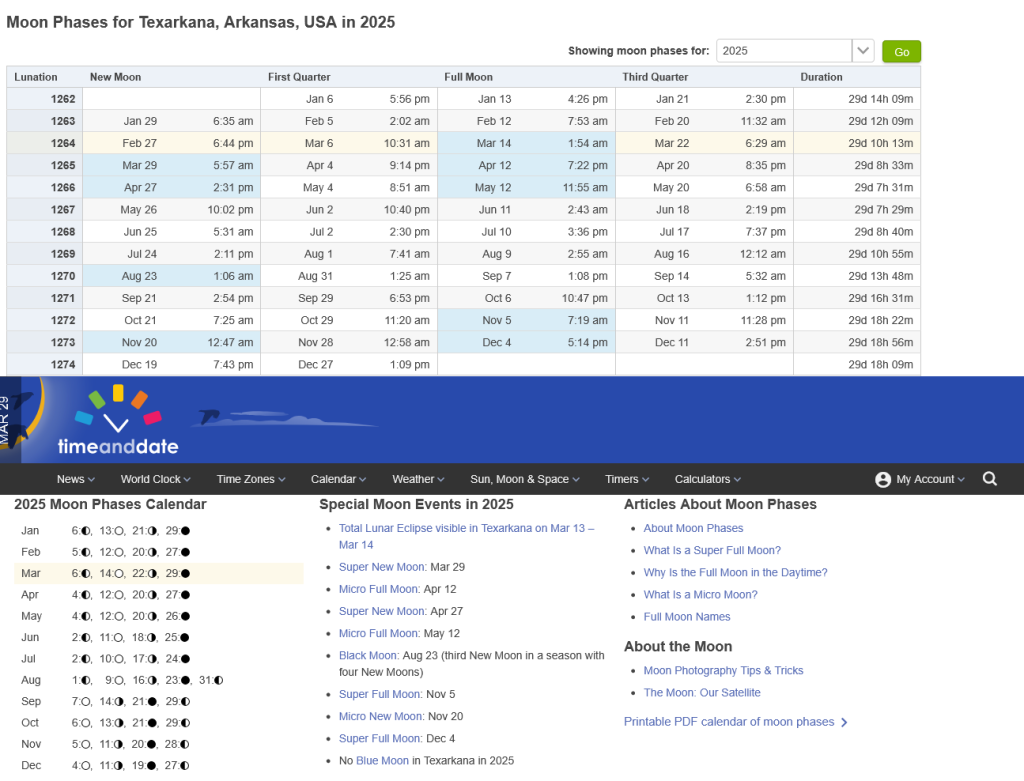
To determine the start of a month we use the NASA Moon Phases Specification based on location. Note you would have to do this for whatever is the current year. The one for Texarkana Arkansas for 2025 is given below. This represents the projected moon phases dates based on NASA. We also use the NASA Daily Moon Guide as shall be discussed later.
Earlier I used some 2024 examples. But now having updated this document I turn to the year we know in America as 2025 on the Gregorian Calendar for our example.
I will first deal with the beginning of the Hebrew year in what we know in America as 2025 on the Gregorian Calendar.
So now let us look at the beginning of the Hebrew year for 2025 using the New Moon Calendar. I will use the location of Texarkana, Arkansas which is my hometown.
For 2025 in America Spring period was March 20, 2025 to June 20, 2025.
To determine the first New Moon in Spring look at the New Moon Phases Guide chart below for Texarkana Arkansas 2025.
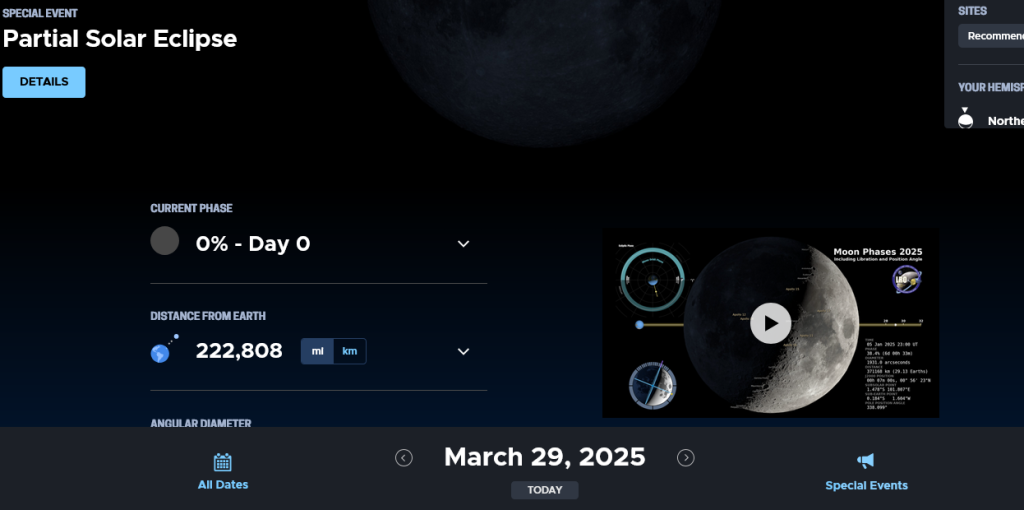
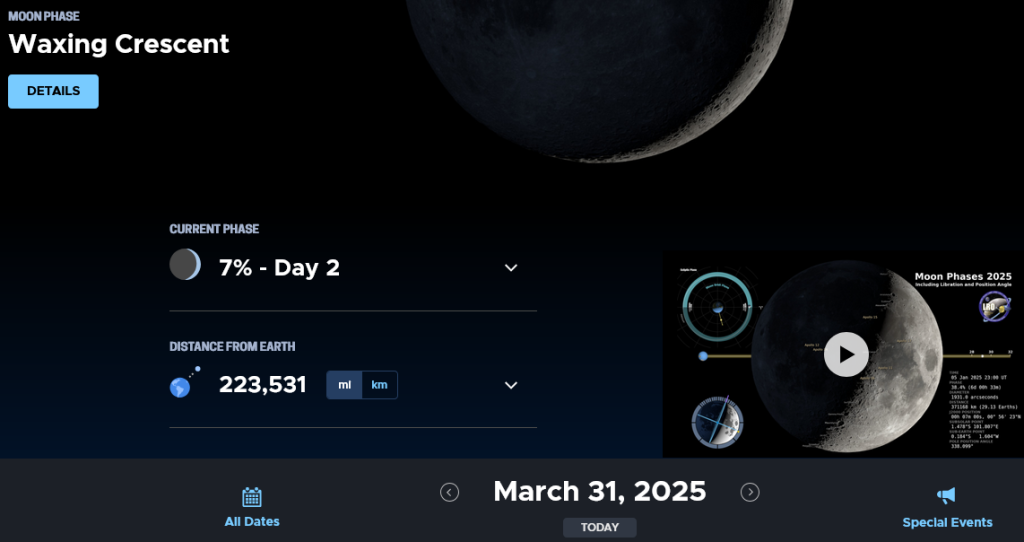
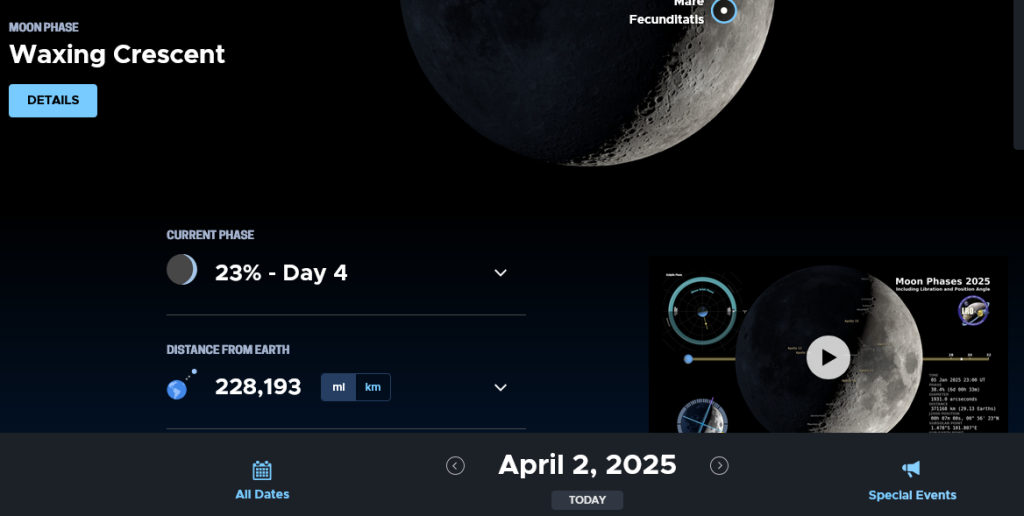
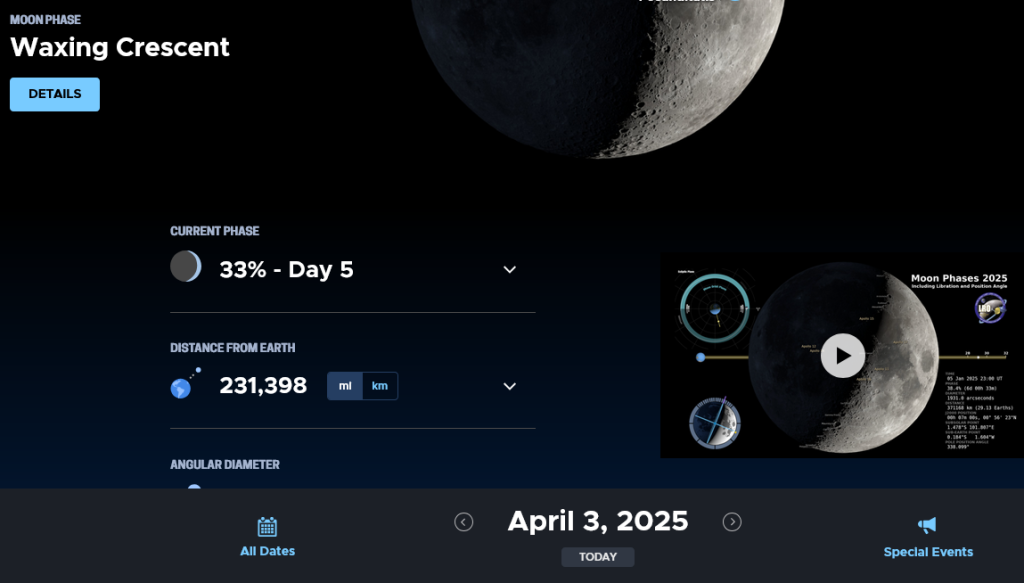
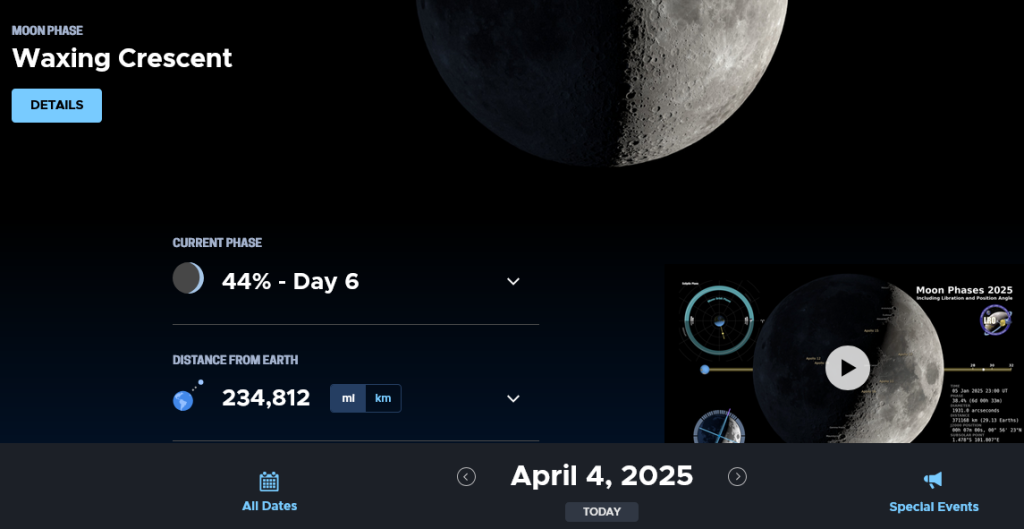
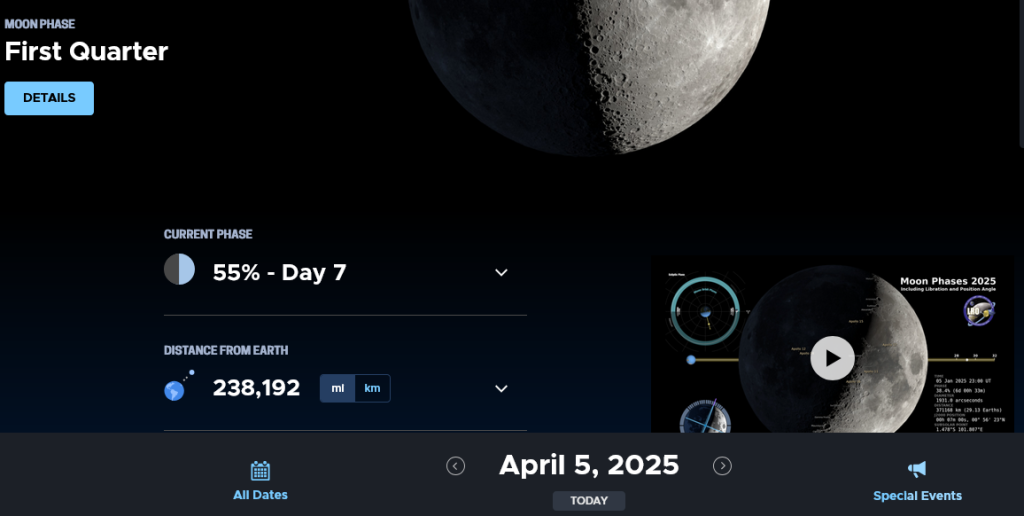
Note date of “New Moon” in the “New Moon” column for the date that first appears after Spring begins. For 2025 that date is March 29 since Spring began on March 20. Next go to NASA Daily Moon Guide and ensure the date obtained from the previous step is selected. In this case March 29.
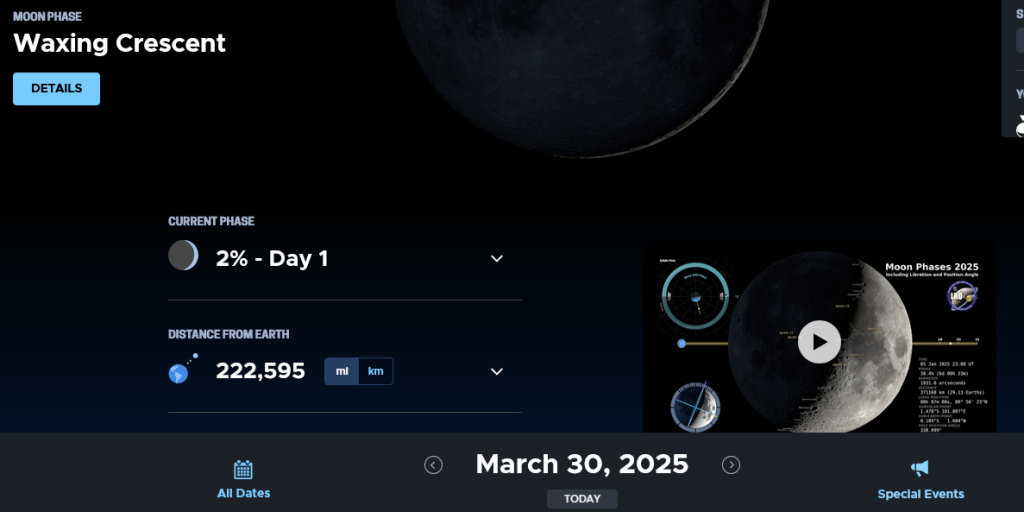
Then increase the date until at least 1% of light shows in the “Current Phase” item which gives the waxing crescent. That will give day 1 for the month of interest based on using waxing crescent to determine new month. But note that some groups increase the date until an amount greater than 1% of light shows which would mean the date for the day 1 of the month would differ.
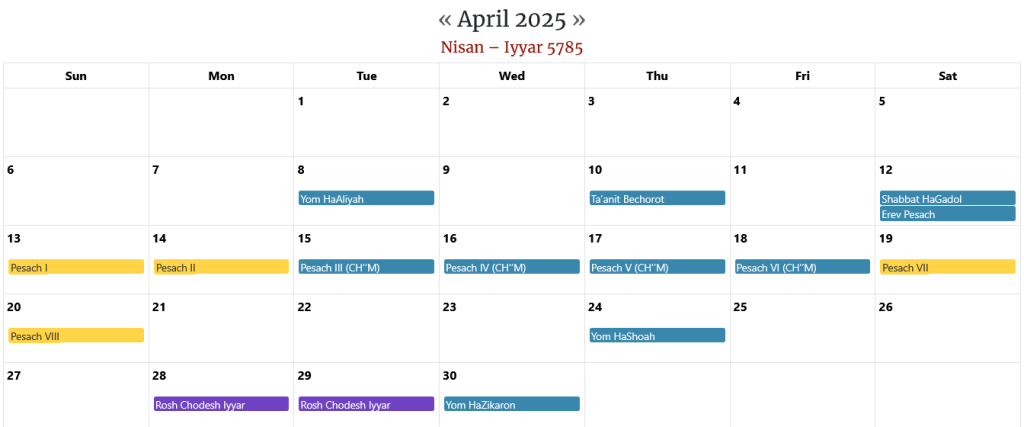
See the following diagrams that indicates the information used to determine that Day 1 of the Hebrew New Year is March 30, 20253 formed from eve of March 29 to eve of March 30, 2025 since Hebrew days starts in the evening at sunset.
These corresponds to the Hebrew calendar at hebcal.com and chabad.org


Additional Information:
Using waxing crescent to determine start of month as it is visible to naked eye depends on location and weather condition
But just assume sufficiently perfect weather and perfect location for NASA and other public institutions to derive their data.
In historical astronomy, before the advent of high-powered telescopes and space travel, both scientists and laypeople would often refer to the new moon as the first appearance of the waxing crescent moon. Today, astronomers sometimes use the term “dark moon” to refer to the period when the moon is in conjunction with the sun and the Earth and is invisible to the naked eye. The term “dark moon” is used to avoid confusion due to the ambiguity of “new moon” terminology.
Let’s first look at the astronomical conjunction. A lunar conjunction is when the sun, moon and earth are directly in line. Because the sun is behind the moon, no sunlight is reflected from the lunar face. The moon is a total blackout during a conjunction. No part of the moon can be seen in an astronomical conjunction.
The average wall calendar portrays the conjunction with a large black dot and calls it a “new moon.” But in reality it is a “no moon.” It is invisible, and a “no moon” conjunction is not what the Bible means by a new moon, which we will see.
NASA new moon is actually a no moon or full moon where there is no moon as it is complete blackness some say whereas the biblical new moon is a visible part of the moon.
The Bible uses the same Hebrew word for both “new moon” and “month.” Therefore, the new moon is linked to and sets the beginning of the month. But on our Gregorian wall calendars the “no moon” conjunction floats all over the 12 calendar months. Modern calendars completely ignore the Biblical way of setting the first day of the month by the visual new moon, even though the word “month” is derived from the word “moon” and should be oriented to the moon as it was intended by the Creator.
Historically, new moon spotters in Israel watched for the thin crescent to establish the beginning of each month. Once seen they reported their sighting to the calendar court authorities of the Sanhedrin. Note what one authority says, “Originally, the New Moon was not fixed by astronomical calculation, but was solemnly proclaimed after witnesses had testified to the reappearance of the crescent of the moon,” Encyclopaedia Judaica, Vol. 12, p. 1039.
The switchover from watching for the first visible crescent to calculating conjunctions to determine the month’s beginning came with Hillel II’s calendar revisions in the 4th century C.E. “By the middle of the fourth century, the sages had established a permanent calendar and the public proclamation of the New Moon was discontinued” (Ibid).
The biblical sighting seems to be based on when the moon is first seen after not been seen though that is not necessarily known for certain.
https://yrm.org/biblical-new-moon
https://spaceplace.nasa.gov/moon-phases/en
https://www.space.com/17561-new-moon-explained-lunar-phases.html
https://sciencing.com/dark-moon-vs-new-moon-5082.html
Book of Enoch and Jubilees 364-Day Calendar
Additional Examples of Different New Moon Determination Methods:
New Moon From Israel No Barley Required
Yahweh’s Assemblies in Yahshua Biblical Calendars