
Last Update: August 27, 2026
Previous Article Title: “Of Male Headship and Women In Ministry – Deep Look at Scripture” Article has been restructured and extended to be more informative.
This article explores two models that deals with the role of Women in Ministry at the regional/local including convention church level. Both presented models say preaching and/or teaching by Women congregationally and elsewhere is authorized by the Bible within the constraints of male headship principle that runs from Genesis to Revelation.. One model says the use of Elder and Pastor as position titles is authorized by the Bible. The other does not but says the position title of Minister should be used for Women rather than Elder or Pastor.
We live in a world of human preferences, not all of which is consistent with the Word of God. We are challenged to know which preference amounts to obedience and which amounts to disobedience. Remembrance of the history of female abuse/oppression and racism sometimes negatively affects us spiritually, mentally, and emotionally as we labor to rightly determine whether something is a matter of righteous obedience or unrighteous oppression.
The purpose here is to describe my position as to the Bible permitted role of Women in Ministry. Its goal is to be consistent with the Word of God being righteously obedient rather than unrighteously oppressive/abusive. It is not something I fuss and fight with people about. If a grown man wants to submit to a woman ruling over him and teaching him spiritually in a class ruling setting, God will judge him on that, whether it be good or bad. Just as God will one day judge me on by refusal to submit to a woman ruling over me and teaching me spiritually in a class room setting, whether it be good or bad.
Although I am Christian first and foremost and do fellowship with multiple denominations, whether predominantly Black or predominantly White, my background is mostly Baptist. Therefore, I will focus on Baptist for this document.
Two major Baptist Conventions I will consider here are the National Baptist Convention USA, Inc. (NBCUSA) and the Southern Baptist Convention (SBC). National Baptist Convention USA is one of the largest if not the largest predominantly Black Baptist Conventions. Southern Baptist Convention is one of the largest if not the largest predominantly White Baptist Conventions. These two Baptist Conventions approach the issue of Women in Ministry in different ways.
It seems that NBCUSA follows the local church autonomy model more strictly than SBC. NBCUSA leaves the issue of women in ministry completely up to the local churches. NBCUSA does not address it in it Articles of Faith. This includes role of women at the national leadership level. In fact, the current NBCUSA wife identifies as Reverend.
On the other hand, SBC Baptist Faith and Message (BFM) in the section entitled “The Church” says “While both men and women are gifted for service in the church, the office of pastor/elder/overseer is limited to men as qualified by Scripture.” I find it interesting that the BFM has no such statement regarding Deacons.
Those SBC churches who have women using a position title of Pastor wholly or in part (or possibly a equivalent function) and do not repent after some time are through a process labeled not in friendly cooperation with SBC. Some in SBC has over recent years attempted to encode no women in pastoral position language in the SBC Constitution. However, there are those in SBC who seems to want SBC to follow a stricter autonomous model and completely leave the decision regarding women in ministry up to local churches without labeling them not in friendly cooperation with SBC. Apparently, a church that is not in friendly cooperation may still identify as a SBC church but it is not allowed to have representation at annual meetings. Of course, some if not all such churches usually after a period of time leave SBC.
For the June 2026 SBC Annual Meeting, Albert Mohler, President of the Southern Baptist Theological Seminary in Louisville Kentucky plans to submit a Constitutional Amendment for voting by messengers that says regarding those churches in friendly cooperation with the SBC: “Does not act to affirm, appoint, or endorse a woman serving in the office or function of a pastor/elder/overseer, specifically preaching to the assembled congregation.” The inclusion of the word function is to prevent churches from hiding the effectively Pastor position through use of words such as Shepherd as seemingly done by one church, Fielders Church in 2025 in response to the concerns of SBC Texas. Fielders Church has since changed its staff position titles to eliminate the use of Pastor and Shepherd for all females; instead it uses terms such as Minister, Leader, and Associate.
It is my view that no modern day elder has the authority to promote any doctrine in speech or practice that is not consistent with what the faithful biblical apostles set forth under the inspiration of the Holy Spirit. Therefore, this document seeks to be consistent with sound biblical doctrines/principles.
Just as in the case of consideration of the Sabbath, when we considers organizational policies we are to be able ministers in spirit more than in letter (2 Corinthians 3:6; Romans 7:6).
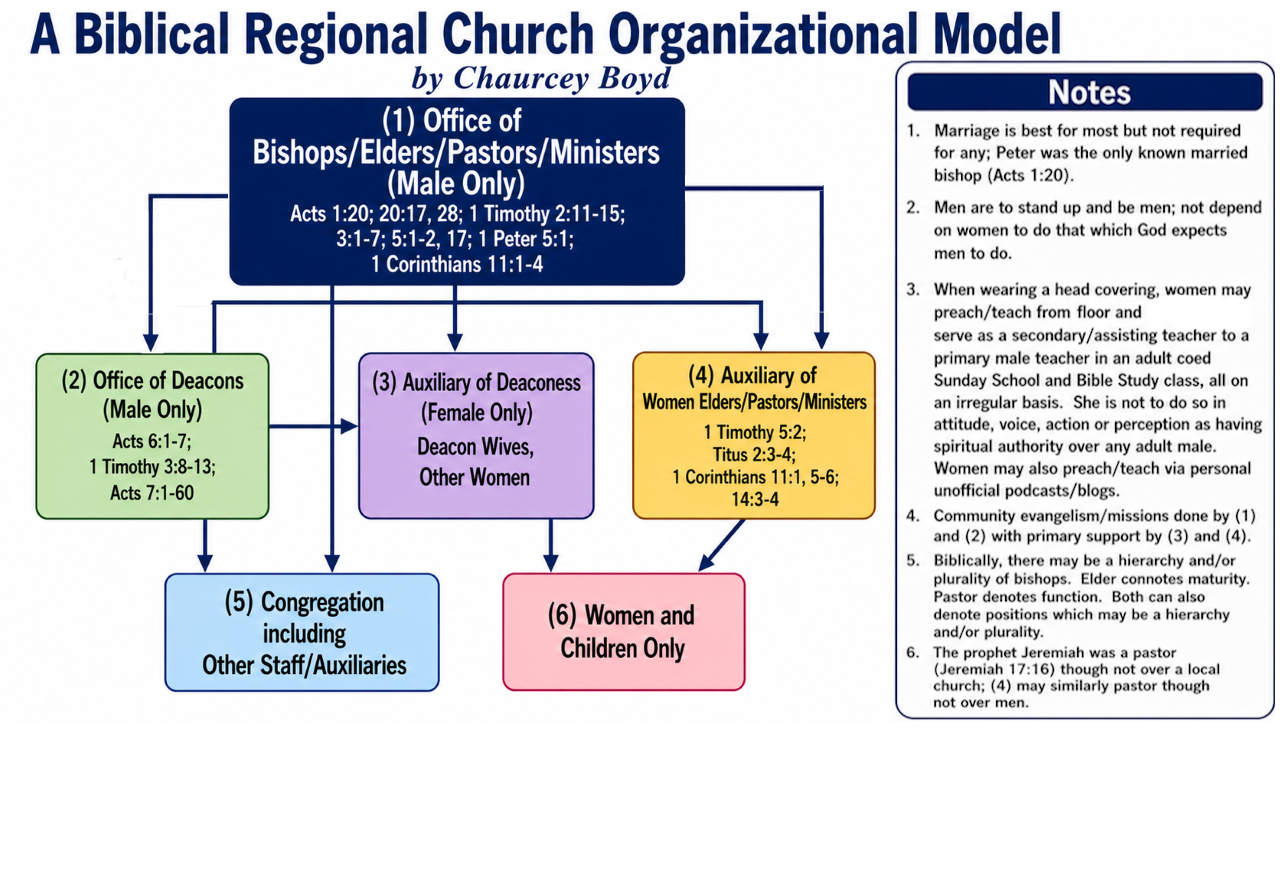
First let me present the diagram of the models. After that I will provide some additional information related to the models.
First Model: Women Allowed to Be Identified as Elders or Pastors but Not Bishops and Not Assistant Elder/Pastor and Not Associate Elder/Pastor Model (Click image to enlarge):
Second Model: Women Not Allowed to Be Identified as Elder or Pastor like they are for the Above Model.
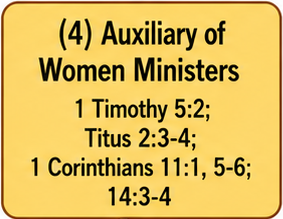
The alternative model above changes (4) leaving all other elements as in the primary model. This model avoids the use of terms such as Elders and Pastors for women while still providing the opportunity for women to oversee, lead, and informally pastor women and children.
Third Model — Based on Cultural Factors Considered But Rejected. Some have suggested that the provisions of 1 Timothy 2:11-12, 1 Timothy 3 concerning bishops and deacons as male only and even 1 Corinthians 11 concerning the head covering and male-female role-based relationship are rooted in cultural traditions. And I indeed did consider that especially with Paul’s use of the words tradition, ordinances, and custom in 1 Corinthians 11. This would mean one would conclude that Paul is saying his preference is that women not teach men rather than saying God has said they are not to teach or rule over adults regarding spiritual matters. But this becomes problematic for me. The question arises is husband head of wife a cultural tradition that is not for the future past biblical days. Is it okay for wife to be bishop over her husband “at church” but not at home? Well one would expect a male bishop who is married to speak to his wife at home about church matters in confidence to get her view of the matter but reserving the final decision-making on the matter. Now if the wife is the bishop and speaks to her husband at home about a matter. Now if the husband sees the matter differently, then who makes the decision? If the wife makes it then she is head of her husband at home; that is not consistent with the husband being the head of the wife at home. Another question that arises is consideration of 1 Corinthians 11:10 which says “because of the angels”. So to me that establishes that head covering is not a cultural matter or at least the principle of male headship is not a cultural matter since the presence of angels is not a cultural matter. So the whole concept of a woman heading a local church is problematic for me. I reject this model.
Pulpit Consideration Across All Models.
The above says it is biblically improper for women to serve as congregation level bishops/pastors/elders/ministers. My position is that still holds even when considering the contents of this section.
Above restricts women to preaching/teaching and leading from the floor.
However, this section establishes an understanding of how some may choose to allow women in the pulpit.
Whether it is proper for a woman to occupy and/or speak/preach/teach from the pulpit is a controversial matter not seemingly made clear in scripture.
Therefore, although I think women in the pulpit present a number of structural and perception problems, my current position is to primarily leave it up to the organized church/ministry in which the woman participates and secondarily to the woman as to whether it is proper for a woman to occupy and/or speak/preach/teach from the pulpit. Some women may choose the pulpit and some may restrict themselves to the floor according to their personal preference.
Below are a number of factors/observations I consider regarding the matter.
In the Bible, seemingly only males served as priestly authorities in the Temple and community.
Women such as Deborah a prophetess did have a high level of leadership and therefore high visibility in the nation of Israel. However, this leadership does not seem to be in a capacity of congregational pastorship.
There are scriptures that show that the Tabernacle and Temple organizational system was designed by God. There are no scriptures that show the synagogue and church building organizational system was designed by God.
In the Temple design instruction God gave to David, God did not command a separate seating area for women and Gentiles; that is a tradition the Jews established during the Second Temple building which was not patterned after the First Temple. Thus, there is no commandment to have a separate seating area for women and men.
In the early church they met in houses. They probably did not have elevated pulpits/platforms; thus, women probably set next to their husbands and that would not present a perception problem especially with the women wearing a head covering.
A policy that allows women in the pulpit does provide high honor to women. However, biblically the woman is the glory of the man; thus, her honor is not to rise to the level of the man.
A policy that does not allow women in the pulpit does reduce some honor given to women; but, it does adequately permit the functionality of the respective office. Allowing women in the pulpit presents a perception problem especially if she is married to a Deacon but also to any man.
Final Thoughts.
Let me give a few points about women in ministry and related concepts.
*The fundamental question is whether a church group whether a regional/local church including a convention or other groupings is willing to obey the Bible or claim liberty to not follow the explicit formulas set in scripture. Yet, I am mindful that 2 Corinthians 3:6 and Romans 7:6 speak of attending to the newness of the spirit of the law rather than the oldness of the letter of the law. That mostly has to do with ceremonial ordinances and the like. I suppose that applies to organizations matters in the New Testament under Christ as long as foundational doctrinal principles are adhered to. Though I prefer the word bishop as used in 1 Timothy 3:1 for head(s) of regional/local churches, I do recognize the flexibility the Bibe gives church organizations to use reasonably equivalent terms such as Elder and Pastor or even Superintendent or Minister or others.
*Male headship principle only applies to husband-wife and church ministry interactions in and outside the church-building. It does not apply to activities like a commercial business such as running a computer business (Proverbs 31:24)
*A Bishop is an Elder, but an Elder is not necessarily a Bishop.
*Biblically there is a hierarchy of bishops – relationally: (1) apostles [Acts 1:20]; (2) regional [Titus 1:5]; (3) local [1 Timothy 3:1]. The same hierarchy principle can be biblically applied to elders and pastors. A plurality of bishops/elders/pastors is also doctrinally sound.
*Catholics changed local church highest leader(s) from Bishop to Priest. Martin Luther changed Priest to Pastor which is seemingly the reason many “Protestants” use Pastor. That change is discussed here.
*There is nothing in the Bible that doctrinally prevents a regional/local church including a convention from creating a hierarchy of elders/pastors that includes subordinate women elders/pastors as long as the male headship including head covering provisions are adhered to. Note that such women are not to be assistants to or associates of the Office of Bishops, Elders, Pastors, and Ministers especially given they are subordinate to the Office of Deacons also. Therefore, they are not to function as Assistant Pastor or Associate Pastor but rather Women Pastor.
*Matthew 16:18 refers to the universal worldwide church Jesus is building. The foundational principles applies everywhere two or three is gathered together in Jesus name for purposes of worship and/or church ministry activities focused on preaching/teaching in contrast to application of biblical principles to everyday life.
*In Judges 4:6-9, Deborah and Barak attitude was that she did not possess authority over him (1 Timothy 2:11-16; 1 Corinthians 11:3-6). Barak failure to totally act as a man should led to a lost of honor.
*On a practical level, the words bishop, elder, and pastor are functionally equivalent such that the word bishop has the sense of rulership, elder of spiritual maturity, and pastor of caring for. Other words used in the Bible (KJV) that are functionally equivalent are Overseer and presbytery. Overseer in Acts 20:28 is the same Greek word translated bishop in 1 Timothy 3:2 and Titus 1:7. Since Acts 20:17 establishes that overseers are the elders to which Paul is writing, the functional equivalence of bishops, elders, and overseers is established at the (1) level. Since the Greek word for pastor is used with respect to overseers in Acts 20:28 that means the word Pastor is also functionally equivalent to elder at the (1) level. In 1 Timothy 4:14 a variant of the Greek word for elder is translated presbytery. Also in 1 Peter 5:1 Peter using another variant that has the sense of co-presbytery or co-elders when he says he is also an elder.
*The basis for (4) allowing women elders: The Greek root word translated elder in 1 Timothy 5:1 and elder women in 1 Timothy 5:2 and elders in 1 Timothy 5:17 is presbuteros, G4245. Hence, in 1 Timothy 5:17 Paul uses the same Greek root word that he used for both male and female in 1 Timothy 5:1-2. This use of the same Greek word root G4245 seems significant and tends to support the view that Paul is referring to spiritual eldership in 1 Timothy 5:1-2, 17 allowing women to spiritual elders over other women though not men. That is in contrast to Titus 2:2-3 which uses different Greek words (G4246 for aged men, G4247 for aged women) and which clearly refer to natural age-based eldership instead of spiritual eldership.
*Deacons are ordained ministers. Some Deaconesses may be licensed/ordained. Such Deacons/Deaconesses may irregularly preach/teach from the floor according to the protocol set by the particular regional/local church/convention. Additionally, Deacons may preach/teach from the pulpit if circumstances call for it. In the models I considered the fact some consider Phebe (Romans 16:1) to be a woman Deacon (Deaconess).
The word Minister (Greek, diakonos, G1249) is generic for various levels of ministry with the context determining its specific meaning. This Greek word (G1249) that is translated Deacon in 1 Timothy 3:8 is the same Greek word translated servant in Romans 16:1 regarding Phoebe. The same Greek word is various translated elsewhere as servants (John 2:9) and minister (Romans 15:8) regarding Jesus, and 1 Corinthians 3:5 regarding Paul and Apollos). This means Phebe could fall under (3) or (4) or been a financial secretary or church clerk. There is not enough info in Romans 16:1 to determine which meaning of the Greek word applies to Phebe.
*Paul uses the terms pray and prophesy for both men and women in 1 Corinthians 11:4-5. The difference is men are to do so uncovered and women covered. This gives the condition in which a woman need not be silent (1 Timothy 2:11; 1 Corinthians 14:34-35) but is to still be in subjection to men (1 Timothy 2:12-15; 1 Corinthians 11:3, 8-10). Presence of the word pray suggests the principle is not limited to spontaneous prophesying but rather all speech, foretelling and forthtelling. Preaching/ teaching are categories of prophesying. Singing and giving thanks to God are other categories (1 Chronicles 25:3; 1 Samuel 10:5) as consequentially is congregational reading of scripture. That is a hard pill to swallow but God knows best strategically and tactically.
*Deaconess and Women Ministers just as Bishops and Deacons may have personal unofficial podcasts, blogs, and other communications channels/media. Since such podcasts/blogs are more akin to the Proverbs 31 woman business, head covering provisions need not apply. However, if such podcasts/blogs are presented as church ministry, the head covering provision does apply. Church ministry podcasts/blogs focus should also be on women and children getting saved and living saved. In all cases the spirit of the male headship principle should be adhered to .
*Women preaching/teaching should occur on special evening/afternoon and less so special morning sessions specifically designated to focus on women and children getting saved and living saved, including Sunday School and Bible Studies so focused. Podcasts/blogs should also be so focused. With respect to coed adult Sunday School and Bible Study and similar classes, the primary/main teacher for a given class should be male. A female can serve as a secondary/assisting teacher to the primary male teacher in which case the female teacher should primarily focus on women and children in the class. All of this is more of a function of attitude than content of presentation. Sunday School Superintendent and Assistants should be from Office of Bishops… or Office of Deacons.
*Note that as established by local churches, women preaching/teaching/leadingmay be done from the floor with head covering.
*Biblically there are no independent women Evangelist in the sense of Philip (Acts 21:8) or work of the evangelist in the sense of Timothy (2 Timothy 4:5). Therefore, all the above models apply even when doing evangelism including evangelistic missions/missionary activities locally and internationally.
*The Bible uses first names. Using first and/or last name or Brother John Doe instead of Elder/Pastor John Doe and Sister Jane Doe instead of Elder/Pastor Jane Doe would reduce use of certain problem. Generic words such as Minister or Reverend may help.
Basic information on the women in ministry positions foundational concepts may be found here.
Basic information on what 1 Timothy and 1 Corinthians 11 has to say about women preaching and/or teaching congregationally and elsewhere may be found here.